
Magic Questioning for Momentum
and other tips for sustaining the creative life

Greetings, Slow Take subscribers! We have many new folks here! I’m poet and essayist, Heather Lanier. The Slow Take is my monthly newsletter, inviting us to lean into what makes us feel more human. Think of it as the opposite of a Botox billboard or an AI-written thank-you note. There are only real thank you’s here. Thank you for being here!
Today’s post is about the creative life. I hope you enjoy! And if you’re not an artist, but still want to read about how to feel more human, stick around for future posts. They’re free!

Lack of momentum in the creative life is sometimes unavoidable. The kid gets sick. The snow day hits. The paid gig demands your all. The chronic pain flares. You spend three days away from your novel or painting or project, and then a full week. Suddenly that project you cared so much about starts to feel like a monster in the closet, and you’re afraid to even open the door, lest it bite you.
What we artists really want is momentum. We want to feel so drawn to a project that we just keep coming back to it, again and again, without much effort. We want the wheels to feel like they’re already in motion, like the project has forward movement of its own, and all we’re doing is showing up to let the work move through us.

Momentum is not easy to generate. I’ve been writing in what I call “fits and starts” all year. I know the news is a large reason. Executive orders keep turning the landscape of my work (higher ed) upside-down. A gaggle of Republicans tried to undo Section 504 of disability law. The State kills and then calls it our fault. Very little of what we hold dear feels safe. In this climate, every creative session can feel hard-won.
But a lack of momentum can turn a creative person’s place of refuge—their art—into a battleground. This year, I’d like to do what I can to keep the wheels of my art moving, so that my creative work is a place for continued renewal rather than struggle. So, as we turn the calendar to another year, it feels like a good time to ask: How can we create more momentum in our creative lives? And how can we sustain that momentum?
If you’re trying to generate some momentum of your own, these tips might help.
Tip 1: Just start. Just show up. A little each day.
This is obvious, and perhaps the most infuriating advice. But it’s also unavoidable. There’s no way to get moving without, well, starting to move.
But here’s a caveat: When trying to establish momentum, some artists make it a point to not work for too long each day. They start with just short sessions. For instance, when Elizabeth Gilbert is starting a new book, she doesn’t bust her butt for hours on Day One. On that first day, she insists on showing up for only an hour. Even if she wants to keep writing, she stops herself. This way, she avoids burnout and naturally feels drawn to the writing desk the next day. She prioritizes the momentum over one killer day.
So that’s the gentle addendum: Just start, but don’t stay too long. Then, repeat tomorrow.
Tip 2: Use small pockets of time to move the wheels a little.
In December, I desperately wanted to finish an article, but the holiday chaos took me away from it for almost a month. By early January, I wanted nothing to do with that article—I’d lost the momentum. I decided to create some by using small cracks of time to think about the piece. While listening to a podcast during a run, I heard a helpful quote, so I snapped a screenshot on my phone, capturing the quote’s timestamp. After the run, I re-listened to that moment on the podcast and typed out the quote at the top of the article’s Word document. Then, I wrote a brief instruction to myself for the next session: See if this quote fits.
That’s it. That’s all I did. Honestly, the quote ended up not being all that useful. But writing it down kept me tethered to the ideas in the piece. And sitting down to write the next day was so much easier when my work was already spelled out for me. “See if this quote fits” felt like a totally doable task.
A few days later, I was scheduled to meet up with two writer-friends for a check-in. We hadn’t seen each other in a month, so I knew we’d probably talk for an hour before getting to work. I was just starting to create some momentum on that once-beastly article, so before the meeting, I decided to eat my breakfast with the Word document opened. This way, I could start thinking about the article before I saw my friends. It was winter break, and everyone was magically asleep in my house, so I just started writing. This meant that when I got to the café, our hour-long talk didn’t feel like a distraction to the writing but a lovely intermission. This also meant that when my friends and I stopped talking and opened our laptops, I was already into my work.
This is a hard lesson, but one I keep trying to remind myself: Don’t scoff at small pockets of time, even fifteen minutes. They might not mean much in the moment, but they can be just what the wheels of the project need to keep moving. After all, the laws of physics say it takes less energy to move something that’s already in motion than it does moving something that’s at a total standstill. Fifteen minutes now can pave the way for a great hour tomorrow.
Tip 3: Engage the Senses, the same way each time.
I did in fact finish my article, and it turned out that music became a big support in sustaining momentum. This is a simple tip, but one I often forget. I write better to music. I’ve known this forever. For the past few years, I’ve been writing to the same 2-hour playlist, but this article needed something different. I stumbled on a soundtrack that felt akin to the subject. (The subject: awe. The album: Sleeping at Last’s Enneagram). I played and re-played the album until the draft was done. Hearing the same songs helped me get into the flow of the subject.
Music doesn’t work for everyone. Some folks need utter silence. But maybe engaging another sense could help your mind reenter the space of your project: lighting the same pine-scented candle before you venture into your book about the forest (smell), or sucking on the same strawberry candy while reentering the world of your 7-year-old protagonist (taste). For sight, you could even gaze at the same work of art just before creating—and return to it in moments of pause while you create.
Tip 4: Find a friendly recipient on the other side of the creative work.
A fourth way I’ve noticed that momentum builds has very little to do with me. It builds when I know there’s someone on the other side of the efforts. A “yes” from a literary journal can rejuvenate my belief in the unfinished stack of poems on my desk. A few readers of this newsletter can reach out and thank me, and suddenly my return to the laptop feels more jovial and at ease.
On the other hand, radio silence can make me slow down, or sometimes even stop for days or weeks.
I worked on individual poems for literal decades before I assembled them into a full-length collection. Part of my reluctance was the grueling road other debut poets reported in publishing their books. I knew the odds were not great. But then I saw a call for open submissions from a publisher that sounded perfect for my work. The editor didn’t even know me. But now I knew her. And her presence renewed my belief in my work. I put together a collection over several months, pitched it to the editor, and had a book contract a month later. (Even now, the timing so shocks me that I had to fact-check my own emails.) Things don’t usually work that fast. But even if the editor had said no, my point is: even the *promise* of someone on the other side of one’s efforts can kick momentum into gear, and keep it moving.
So, my suggestion is to find, invent, or imagine a friendly recipient on the other side of your endeavors. Pick a book prize you think might be a good fit for your work, and use its deadline as a finish-line. Or just ask a good friend if they’ll respond to what you’ve made in one month. If you’ve ever gotten a positive response on your creative work, type it up and frame it and tack it above your workspace. Channel your creative efforts toward that kind audience member.
Tip 5: Leave yourself breadcrumbs for tomorrow.
After each writing session, I like to write the smallest instructions for myself, explaining what I might get done the next time I write. This way, when I sit down to my desk, all I need to do is look at my notes to myself and just follow my gentle orders. Sometimes, the smaller the instructions, the better. For instance, “Find a place for this quote” is way easier than “Finish the whole essay.”
Fans of Kendra Adachi will recognize that I’m describing one of her “Lazy Genius” principles: “the magic question.” She phrases the magic question like this: “What can you do now to make things easier later?” I always thought of “the magic question” as a tool for efficient housework (e.g., pull the crockpot out tonight, so tomorrow morning I remember to start the soup.) This is often how Apache applies it. But it turns out, the magic question can help with artistic momentum. It helps the wheels of a project keep moving, just a little.
Because that’s really the question: Not how to start momentum. After all, to get a car started, you just turn the key in the ignition. The bigger question is: how to sustain momentum?
The energy required to push a still object up a hill—an object that had slowed to a stop—that’s what I did again and again last year. It’s a fine way to work. I’ve published whole essays that way. But it takes tremendous energy, and it’s not as fun. This year, I’d like to do what I can to keep the wheels of my art moving, so that my creative work is a place for continued renewal rather than struggle.
If you have tips of your own, will you share them below?
Huge thanks to Merideth Hite Estevez for letting me process these discoveries via Voxer! Art-making pals are the best.
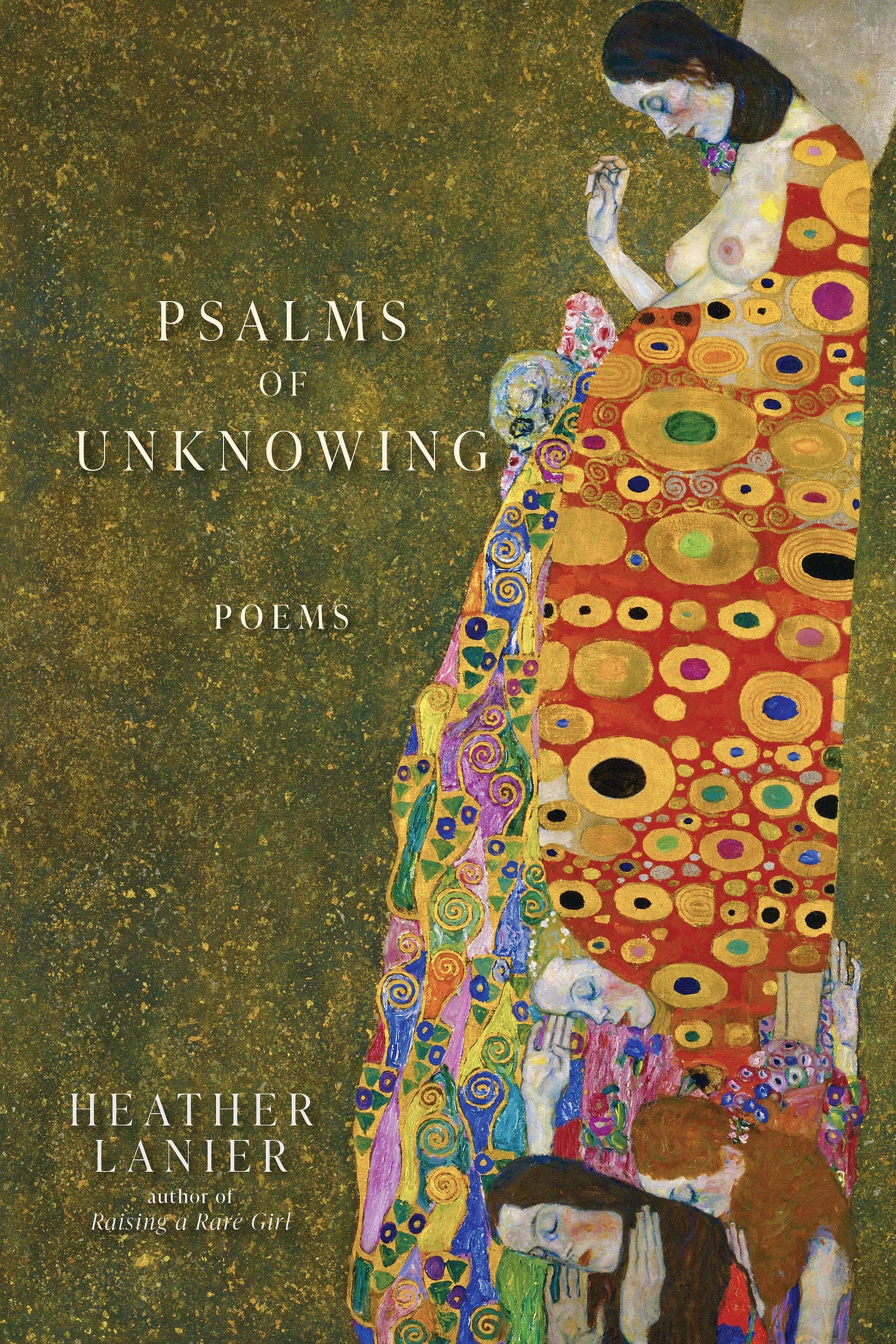
You can order a copy of my poetry collection, Psalms of Unknowing, wherever books are sold. Kirkus calls it “a powerful poetic reckoning with motherhood and religion.”
When I’m in a lull, I write on my notes app on the elliptical at the gym in the morning. It feels so low stakes, I have 30 min, and if I can drop into a train of thought I can sustain it when I get home. Whatever works!
Aww, thanks for the shout out. My tip is “become friends with Heather Lanier and instantly be inspired!” ❤️🙏😌